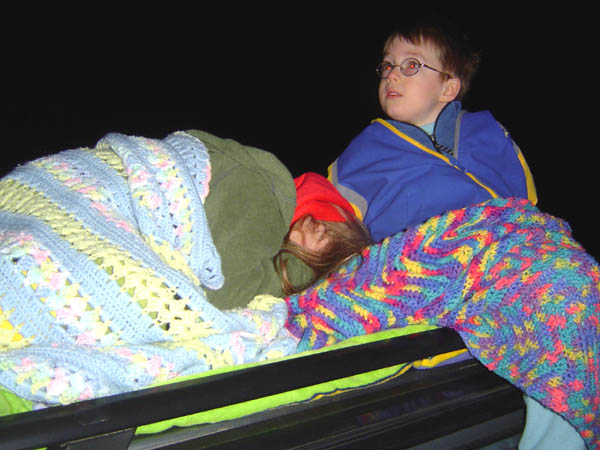
Maddy and Brock on top of the minivan in Carnation, WA, waiting for the start of the meteor shower at 3 AM. Maddy is holding her ears as she is expecting a loud boom.
The oldest known meteor shower, the Lyrids, peaks this year on the morning of April 22 just four days after the Full Moon.
The early morning hours of April 22, between 3 a.m. and dawn, are the best times to watch for Lyrid meteors no matter where you live. The shower's peak is expected sometime between 22h UT on the 21st and 05h UT on the 22nd. Some activity from this shower can be seen from about April 16th to 25th, but the rates will be much lower away from the peak.
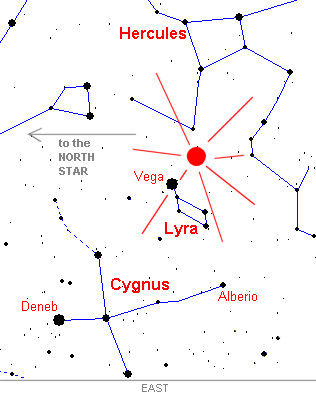
The constellation Lyra, pictured in the sky map below, rises at approximately 11:00 p.m. local time at mid-latitudes in the Northern hemisphere. The radiant of the shower is located near Vega, a hard-to-miss zero-magnitude star. Vega is well known as a member of the Summer Triangle of bright stars, which also includes Deneb and Altair. To find Lyra at 3:00 a.m., go outside and face north-northeast. Vega will appear approximately 60 degrees above the horizon between the constellations Cygnus and Hercules.
The rate of meteor activity is usually greatest near dawn because the earth's orbital motion is in the direction of the dawn terminator. Earth scoops up meteoroids on the dawn side of the planet and outruns them on the dusk side.